The Covid Pandemic has merely emphasised what we already knew, that there is an ‘epidemic’, and certainly endemic domestic abuse across the UK. Even in the early stages of the Pandemic, charities like Women’s Aid were identifying the increased risk of harm and isolation for those affected by domestic abuse. The increase in reported incidence of domestic abuse (ONS Crime Survey Statistics) as the Pandemic progressed has prompted some to consider whether domestic violence can be described as ‘a pandemic within a pandemic’. In addition to the human costs, the costs of domestic abuse to the public purse was estimated pre-pandemic to be in the region of £66 billion across England and Wales alone.
The overall evidence base is very clear about:
- The numbers of children affected by domestic abuse (about 1 in 5).
- The connection between domestic abuse and substance misuse, also significant mental ill-health, amongst perpetrators as well as victims.
- How domestic abuse affects both men and women of all ages, women and girls (particularly younger women) are disproportionately affected.
- Children who are brought up in households with domestic abuse being more likely to repeat the cycle of abuse and/or harm their health as adults.
Even pre-Pandemic, national policy and legislation was developing and has now come to fruition. An example of this includes The Domestic Abuse Act 2021 (England) requiring local authorities and partner organisations to develop a strategy for (accommodation-based) domestic abuse support and to regularly monitor its effectiveness (s.57 (1)). Wales has for several years made a direct connection between violence against women, sexual violence, and domestic abuse and the National Strategy requires a collaborative, strategic approach to the commissioning and provision of support services. Collaboration is overtly cited in the Strategy as a mechanism for improving the focus (on domestic abuse and sexual violence) but also enabling better flexibility and value for money.
In both jurisdictions, short term funding has been made available from the centre but there is anxiety in the sector amongst commissioners and providers about its sustainability. The market for domestic abuse support is currently quite static and could benefit from widening. However, providers must contend with short-term funding plus an array of commissioners and funders including the Home Office, Public Health, Police and Crime Commissioners, Local Authority Children’s and Adults’ Services, Health and Housing. It is rare to see effective joint commissioning that provides a sustainable vision for services and it’s not a particularly attractive market to be in, or move into.
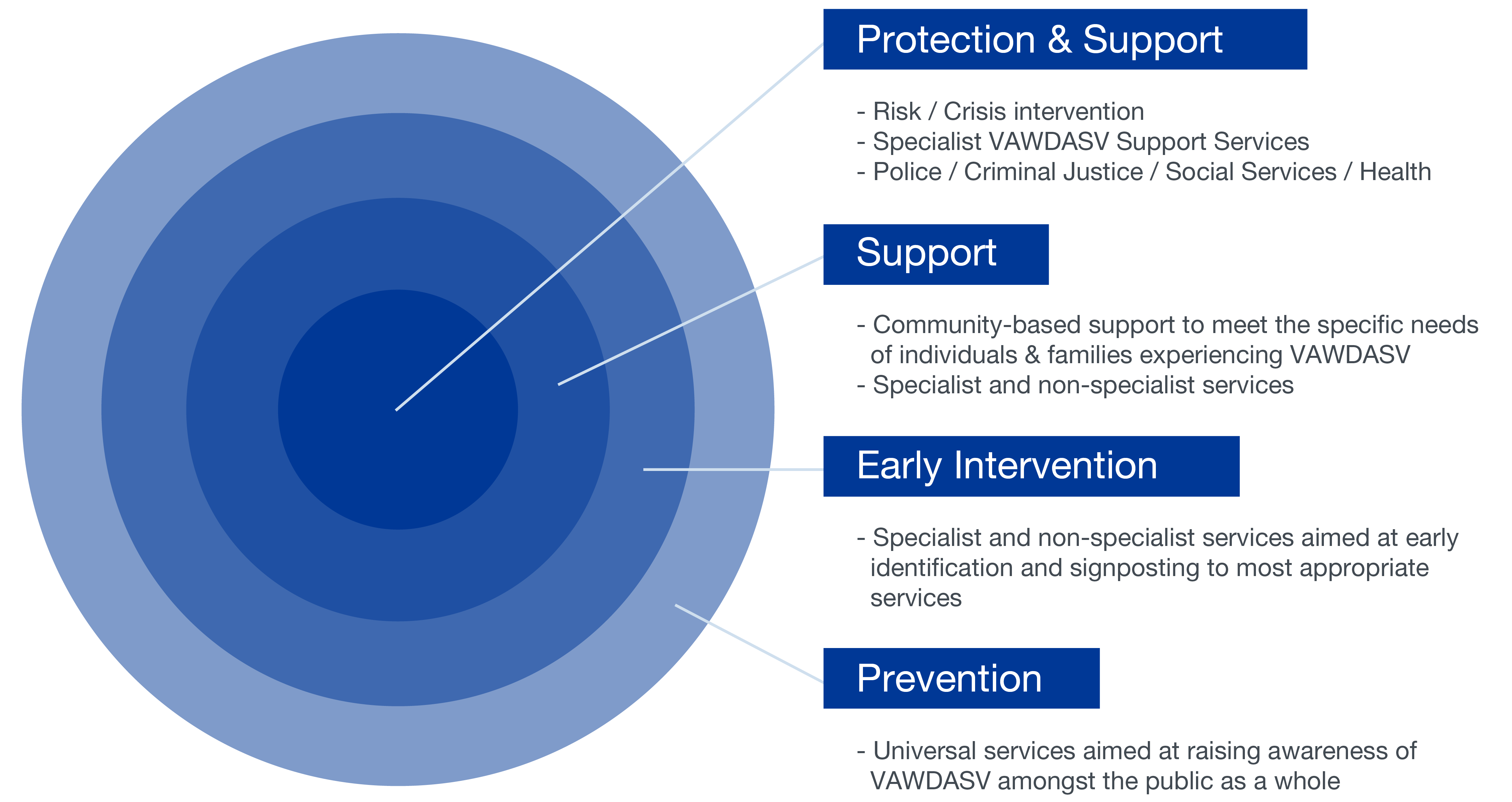
An example of good practice can be found in Mid and West Wales. Here four local authorities, two health boards, the Police, the Community Safety Partnership and the Office of the Police and Crime Commissioner, have worked together to support the (re) commissioning of Violence Against Women, Domestic Abuse and Sexual Violence (VAWDASV) services. A core ambition was to develop a common overarching specification. The aim was to recognise the broad range of services that are needed to prevent abuse from happening in the first place, plus provide protection and support for survivors. See diagram below:
Sphere of Service Types Diagram[1]
IPC have been working with many other local authorities (on an individual or collective basis) and with the 3rd sector. Our aim was to evaluate service innovation and undertake needs and services mapping/analysis to inform the future strategic direction. Whilst there are some excellent well-established and more innovative services, our work suggests that gaps remain including:
- Domestic abuse involving older people.
- How to support people as they step down from a usually time-limited period of accessing ‘specialist’ domestic abuse supports and recognising that there are usually other ongoing needs. For example, for emotional wellbeing or housing. Not enough is known about the relative (cost) benefits of providing this kind of support to prevent repeat victimisation or perpetration of abuse.
- How best to organise ‘whole family’ support, particularly to benefit children and young people as well as perpetrators. The Early Intervention Foundation has recently (2021) described a ‘mountain to climb’ to support child victims.
- Support for LGBTQ or BAME populations.
- How best to invest in sustainable preventative programmes (including with children and young people).
- How best to engage with fathers /men/perpetrators more generally.
We prepared a rapid research review for Wiltshire County Council in 2020 and this can be downloaded on our website here.
Resources on our website that may be useful for commissioners and service managers include:
- Barnardo’s Cymru opening closed doors programme evaluation final report
- Opening closed doors programme evaluation
- Promoting good outcomes for children in need who experience domestic violence
- Case study – Support for regional commissioning of violence against women domestic abuse and sexual violence – VAWDASV services in mid and west Wales
- Carmarthenshire Council – Outline Service Specification Framework for Mid and West Wales Domestic Abuse Services
Useful links to resources / publications on other websites:
- The Early Intervention Foundation
- Womens Aid
- The Royal College of Nursing
- Refuge
- Safe Lives
- ONS Domestic Abuse Statistics
[1] From the Regional Framework for Service Development and the Commissioning of VAWDASV Services in Mid and West Wales, 2019